
Torque-based Rheology-buildability Evaluation for 3D Concrete Printing
On November 25, 2024, the 5th International Conference on 3D Construction Printing (5-IC3DcP) was held at the Charles K. Kao Auditorium, Hong Kong Science Park.
At the international event hosted by the City University of Hong Kong, Beijing NELD made an in-depth technical report on "Torque-based Rheology-buildability Evaluation for 3D Concrete Printing".
In a collaborative study with industry partners, the R&D team of NELD used three advanced torque measurement devices to systematically analyze the static and dynamic torque characteristics of 3D concrete printing materials. Through the innovative establishment of three-dimensional integrated cloud map, it provides scientific pre-screening methods and engineering application guidance for the buildability of 3D printing materials.
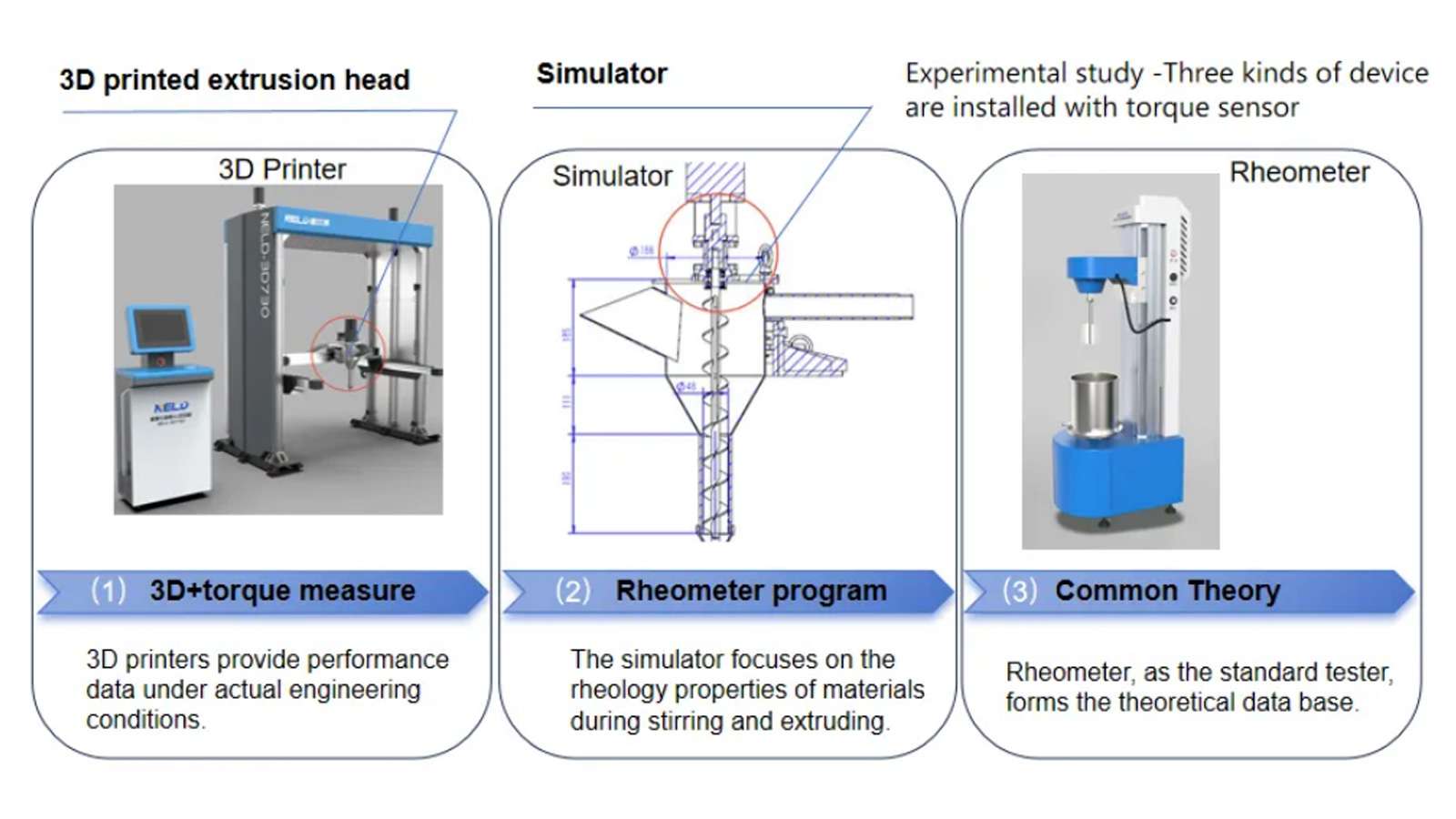
Three rheological measuring devices with different structures
Through rigorous experimental verification, the R&D team of NELD successfully established the corresponding relationship between dynamic torque, viscosity index and the number of printing layers, and innovatively used cloud map to characterize it. And the cloud map can be customized and created based on the hardware parameters of different printing devices, providing an important early prediction tool for the printability evaluation of 3D concrete printing. And in the verification process, the rail gantry 3D printer independently developed by NELD was adopted (effective working space 4m×8m×4m), which is equipped with a rotating print head, nozzle diameter φ20mm, travel speed 60mm/s, and can print more than 139 layers.
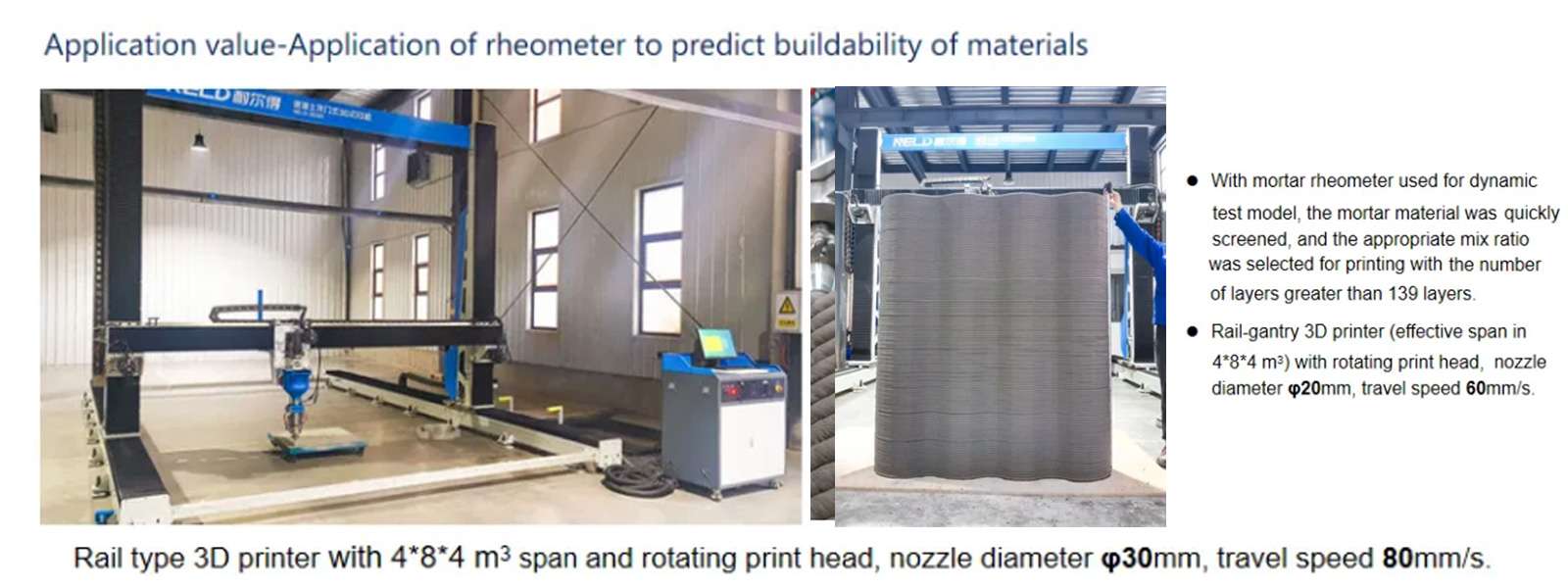
The rail gantry 3D printer
In order to further verify the accuracy of the prediction model, the R&D team of NELD also conducted print verification tests with nozzle diameter φ30mm and travel speed 80mm/s. And the results show that under the same material serials, the cloud map also shows good stability and reliability in predicting the printing height of different nozzle diameters.
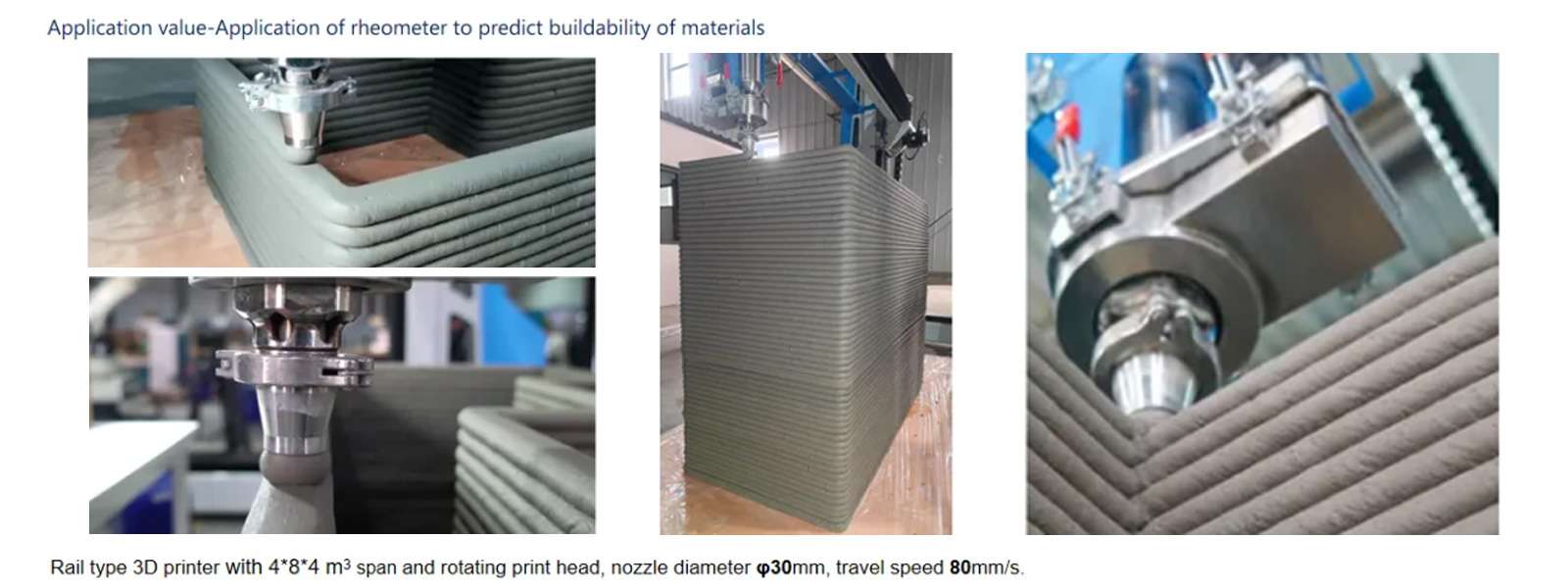
At present, 3D concrete printing technology is in a booming stage. While the breakthrough of this technology not only depends on the innovative iteration of equipment, but also requires accurate and reliable material property evaluation and control system.
The torque-based rheology-buildability evaluation system innovatively established by NELD provides a strong support for the accurate prediction and control of the print quality of concrete materials. With the continuous improvement and standardization of the evaluation system, it will play a greater role in promoting the large-scale application of 3D concrete printing technology in the field of construction engineering.
Beijing NELD will continue to uphold the concept of technological innovation, work with industry partners to jointly promote the development of 3D concrete printing technology, and contribute wisdom and strength to the industrialization of construction.